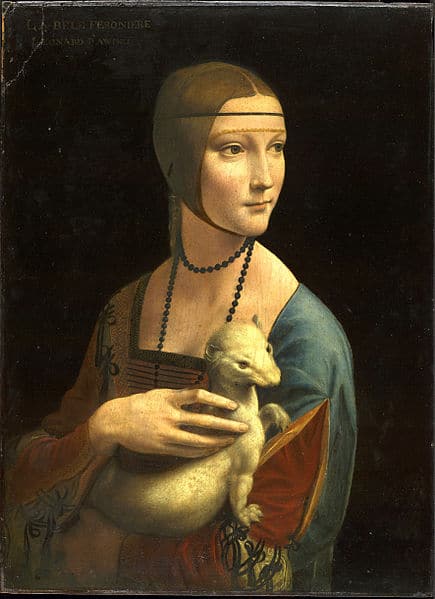
From the bustling, innovative courts of Renaissance Milan to the historic, culturally rich city of Krakow, the journey of Leonardo da Vinci's Lady With an Ermine is as captivating as the enigmatic smile of its subject. This iconic portrait, a testament to Da Vinci's genius, has traversed centuries, survived wars, and witnessed profound societal shifts, solidifying its status as one of art history's most treasured masterpieces. But beyond its undeniable beauty, the painting is a rich tapestry of symbolism, personal stories, and an extraordinary saga of ownership that eventually brought it to Poland.
The Milanese Dawn: Birth of a Masterpiece
Circa 1489-1490, a pivotal period in the career of Leonardo da Vinci, saw him serving under the patronage of Lodovico Sforza, the ambitious Duke of Milan. It was during this intensely creative time that Da Vinci began work on a portrait that would redefine the genre: the Lady With an Ermine. The subject was none other than Cecilia Gallerani, a young woman of remarkable intellect and beauty, who at just 16 years old, had become the Duke’s mistress.
Cecilia was far more than just a passing fancy; she was a cultivated woman, born into a prominent Sienese family, known for her education in Latin, her musical talents, and her poetic abilities. She met Lodovico Sforza in May 1489, after moving to the Monastero Nuovo. Their intellectual connection quickly blossomed into a profound relationship, one that Da Vinci sought to capture on canvas. Unlike static, formal portraits of the era, Leonardo's depiction of Cecilia Gallerani pulses with life. Her head is turned sharply, her gaze directed to something or someone beyond the frame, creating a sense of movement and immediacy that was revolutionary for its time. Da Vinci’s mastery of sfumato, though perhaps more subtle here than in some of his later works, lends a softness to her features, blurring the transitions between light and shadow and contributing to the portrait's profound sense of naturalism.
Decoding the Ermine: Symbols, Puns, and Royal Allusions
The most striking element of the portrait, aside from Cecilia herself, is the animal she cradles: a pristine white ermine. Far from a mere pet, the ermine is laden with layers of symbolic meaning, a hallmark of Renaissance art and Da Vinci's intellectual prowess. The weasel, in its winter coat, was traditionally associated with purity and chastity. Its presence in Cecilia’s arms could, therefore, be seen as a metaphorical portrayal of her character, a depiction of her as a chaste and wholesome lady, despite her unconventional relationship with the Duke.
However, Da Vinci, ever the intellectual jester, wove in more intricate allusions. The Greek word for weasel is "galee," a sound remarkably similar to Cecilia’s family name, Gallerani. This clever visual pun, understood by the educated elite of the era, added a layer of intimacy and wit to the portrait, revealing Da Vinci’s close understanding of his sitter and her circle.
Perhaps the most significant symbolism, however, links directly to the Duke of Milan himself. Lodovico Sforza was known by the nickname "Italian Moor, White Ermine," a title he earned after being awarded the prestigious Order of the Ermine by the King of Naples. Given that Sforza was already planning his marriage to Beatrice d’Este, a public portrayal of him alongside his mistress would have been scandalous. Da Vinci, with his characteristic ingenuity, found an allegorical way to include the Duke in the portrait through the ermine. This subtle inclusion allowed Sforza to be present, yet discreet, in a painting celebrating his intellectual and artistic companion. Art historians also speculate that the ermine might have served a dual purpose: to delicately conceal Cecilia's rumored pregnancy with Sforza’s son, Cesare, born shortly after the portrait's completion.
The interplay of these symbols transforms the Lady With an Ermine from a mere likeness into a sophisticated intellectual puzzle, inviting viewers to delve deeper into its historical and personal contexts. It highlights Da Vinci's ability to imbue his subjects with profound narrative depth, making each element a key to unlocking the sitter’s story and the circumstances surrounding her life.
A Canvas of Secrets: Artistic Techniques and Hidden Changes
The Lady With an Ermine is an oil painting on a relatively small wooden panel, measuring 54.8 x 40.3 cm. This medium allowed Da Vinci the flexibility to achieve the subtle gradations of tone and light for which he is famous. The painting's original state, however, was not quite what we see today. Scientific analyses, including X-rays, have revealed fascinating insights into the creation and subsequent alterations of the portrait.
Originally, the background was not the stark, dark void that now envelops Cecilia. X-rays have shown traces of a door or window in the background, suggesting a more elaborate setting that was later painted over. Furthermore, the painting underwent significant retouches. For instance, Cecilia’s transparent dress was made more opaque, and its color was adjusted to harmonize with her hair. Her hairstyle itself was also modified, with her hair initially extending further down towards her chin. These changes, whether made by Da Vinci himself or by later hands, reflect evolving aesthetic sensibilities or perhaps efforts to refine the portrait’s composition.
Beyond these technical adjustments, there have been intriguing speculations regarding the painting's authorship. While widely attributed to Leonardo da Vinci, some scholars have, at various points, suggested the involvement of his pupils, such as Giovanni Antonio Boltraffio or Ambrogio de Predis. However, the overwhelming consensus among art historians today firmly places the masterpiece in the hands of Leonardo, citing the unmistakable genius in its execution, the innovative pose, and the psychological depth that only Da Vinci could achieve. The painting stands as a testament to his groundbreaking approach to portraiture, moving beyond mere representation to capture the soul and intellect of his subjects.
The Grand Tour: From Italian Palaces to Polish Pride
The journey of the Lady With an Ermine from Italy to Poland is a tale of art appreciation, political upheaval, and remarkable preservation. The painting's Polish chapter began around 1800 when Prince Adam Czartoryski, during his travels through Italy, acquired the portrait. He purchased it as a gift for his mother, Princess Izabela Czartoryska, a formidable art lover, collector, and the visionary founder of the Czartoryski Museum.
Initially, Princess Izabela was not entirely enamored with her son’s gift. She particularly disliked the original blue background of the portrait (a different 'original' background from the one revealed by X-rays, suggesting multiple historical changes). In a decision that today would send shivers down an art restorer's spine, she had the background painted over with a uniform black, the same background we see now. Fortunately, despite her artistic intervention, she recognized the painting's value and ensured its place in the Czartoryski family collection, first displayed in their Gothic House in Puławy.
The portrait's existence in Poland was not without peril. During the tumultuous November Uprising against Russian rule in 1830-1831, the painting was secreted away to Paris to protect it from war. It remained in exile for decades, becoming a symbol of Polish cultural heritage that refused to be extinguished. Towards the end of the 19th century, the painting finally returned to Polish soil, finding its permanent home in Krakow as a centerpiece of the newly established Czartoryski Museum. Over the centuries, it has faced further threats, notably during World War II when it was plundered by the Nazis but miraculously recovered. After extensive renovations that began in 2010, during which the painting toured prestigious museums abroad, the Lady With an Ermine triumphantly returned to the Czartoryski Museum, where it is now proudly displayed as one of Poland's national treasures.
Preserving a Legacy: Visiting and Appreciating the Lady Today
Today, the Lady With an Ermine stands as a jewel in the crown of the Czartoryski Museum in Krakow, a beacon of Leonardo da Vinci’s enduring legacy and a testament to centuries of Polish patronage and preservation. For art enthusiasts and history buffs alike, a visit to Krakow offers a unique opportunity to stand before this extraordinary work.
When planning your visit, consider these tips to enhance your experience:
- Book Tickets in Advance: The Czartoryski Museum is a popular destination, and the Lady With an Ermine draws significant crowds. Pre-booking your tickets online can save you valuable time.
- Arrive Early or Late: To avoid peak crowds and enjoy a more intimate viewing, aim for the first or last hours of opening.
- Allow Time for Reflection: Don’t rush past the painting. Take a moment to observe the details: the delicate brushstrokes, the texture of Cecilia’s skin, the intelligence in her eyes, and the intricate symbolism of the ermine. Notice the light playing across her features and the animal’s fur.
- Explore the Museum: The Czartoryski Museum itself holds a vast collection of art and historical artifacts, offering a comprehensive look into Polish and European culture.
- Consider a Guided Tour: A museum guide or an audio guide can provide deeper context and uncover nuances you might otherwise miss, enriching your understanding of the painting's history and significance.
Seeing the Lady With an Ermine in person allows for an appreciation that no reproduction can fully convey. The scale, the subtle shifts in color, and the palpable energy of a work created by one of humanity's greatest minds truly come alive. It's an opportunity to connect with history, art, and the intricate human stories that have unfolded around this magnificent portrait for over 500 years.
The journey of the Lady With an Ermine, from the vibrant intellectual milieu of Renaissance Milan to its celebrated status in Krakow, is a saga of artistic genius, historical intrigue, and remarkable resilience. It encapsulates not only Leonardo da Vinci’s innovative spirit but also the personal narrative of Cecilia Gallerani and the tumultuous history of its journey through Europe. This portrait remains a timeless masterpiece, a window into a bygone era, and a powerful symbol of the enduring human capacity to create, protect, and cherish beauty across generations.